Martial arts used for self defense or combat in an actual street altercation is very different than training at a dojo on very soft, forgiving mats with a friendly training partner.
The main difference between street fighting and a self-defense situation is that a street fight is avoidable, whereas a self-defense situation is not. The other main difference is that the fight is consensual between both parties.
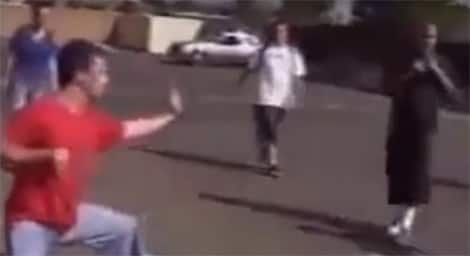
In this video, two boys agree to a street fight. One of them didn’t know the other one was a student of the martial arts. You can probably figure out what happens next.
A typical situation might involve two men arguing in a bar, then one suggests stepping outside, where the fight commences. Thus, it is often possible to avoid the fight by backing off, while in self-defense, a person is actively trying to escape the situation, using force if necessary to ensure his or her own safety.
Chinese martial arts, which are called kung fu or gung fu and wushu, are a number of fighting styles that have developed over the centuries in China. These fighting styles are often classified according to common traits, identified as “families”, “sects”, or “schools” of martial arts.
There are styles that mimic movements from animals and others that gather inspiration from various Chinese philosophies, myths and legends. Some styles put most of their focus into the harnessing of qi, while others concentrate on competition.
The 5 Kung Fu animal styles of the Chinese martial arts:
Kung Fu Animal Style #1: Tiger tends to charge the opponent and attack directly with brute force, uses circular arm movements to overwhelm the enemy, relies on the arms but occasionally uses low kicks.
Kung Fu Animal Style #2: Leopard strikes quickly to inflict pain, then follows up for the kill.
Kung Fu Animal Style #3: Crane keeps the opponent at a distance and capitalizes on the length of the arms and legs, tends to strike with the very end of the natural weapons, attempts to overwhelm the enemy with rapid hand strikes, evades using circular movements.
Kung Fu Animal Style #4: Snake relies on awareness, employs coiling motions and hisses to intimidate, uses whipping toe kicks to the lower half of the opponent’s body, utilizes simultaneous striking and locking techniques, avoids using the traditional fist.
Kung Fu Animal Style #5: Dragon uses quick, snapping kicks that hit with the blade of the foot; uses the full fist and the forearms to strike; may combine physical techniques of the other Shaolin animals.

The following martial arts systems are either influenced by other cultures or possess a lineage that started after 1940:
Hong Cha
Jeet Kune Do – Bruce Lee’s Way of the Intercepting Fist, it incorporates concepts from Chinese martial arts
Jing Quan Dao – A modern synthetic style
Kenpō – Japanese description of various Chinese arts
Kuntao – Way of the Fist, a Hokkien term referring to Chinese martial arts practiced in Southeast Asia and Indonesia in particular
Liu Seong Kuntao (also Liu Seong Gung Fu, Liu Seong Chuan Fa) – a Chinese art with Indonesian influence, practiced primarily in the United States
Sanshou or Sanda – Free Fighting
Shaolin-Do – Translated as the Way of Shaolin
Wushu (sport) – Exhibition and a full-contact sport derived from traditional Chinese martial arts.