The UFC was not the first mixed martial arts event of the modern era. There was parallel development in Japan.
UFC 1 was on November 12, 1993.
A league in Japan featured real, highly-organized bouts that could end by submission on the ground, or KO from standing, or via a judge’s decision based on grappling and striking. The first professional event was in 1989. The first amateur event was even earlier, in 1986.
The organization was called Shooto, and grew out of a work that turned into a shoot.
In 1985, Satoru Tiger Mask Sayama faced Akira Maeda in a worked, but hard bout, when Maeda started throwing real strikes and intentionally kicked Sayama in the groin. Sayama promptly disavowed professional wrestling, wrote a tell-all book exposing it as fake, and formed the world’s first modern MMA organization – Shooto.
In order to understand the history, it helps to know the difference between a Fix, a Work, and a Shoot.
A Fix
A ‘fix’ is a fight, purportedly legitimate, where one fighter knows the outcome, and the other does not. Professional boxing has proven to be an unfortunate source for hundreds of years of fixed fights, with the usual cause being gambling.
May 18, 1771, in England, Peter Corcoran knocked out Bill Darts in the first round. The promoter, a noted gambler, Colonel Dennis O’Kelly, allegedly paid Darts 100 pounds (roughly US $10,000 today) to lose the match.
The Jake LaMotta vs Billy Fox real life fix was a central element in the Martin Scorsese’s Raging Bull. And it was a fix that led Marlon Brando’s Terry Mallot in On The Waterfront to say “I coulda had class. I coulda been a contender. I coulda been somebody, instead of a bum, which is what I am, let’s face it.”
During the 1960s, Congress investigated organized control in boxing and discovered that fixing fights was at the heart of mob influence.
Even today there are occasional rumblings about fixes in boxing.
A Work
A ‘work’ is a contest where both competitors knows the outcome. Pro Wrestling bouts are works – generally, the promoter dictates when the contest will end, and how, and the two athletes improvise the rest.
The Japanese pro wrestling scene often specializes in what is termed a ‘hard work’ where the outcome is predetermined, but the the contact is heavy, and the technique is often quite realistic.
Pro wrestling, as it can be whatever the promoter wants, and thinks will be the most compelling to the audience, often serves as a window on the character of the audience. Americans like drama, so the WWE is essentially a soap opera on steroids, literally.
The Japanese admire stoicism, so puroresu often features stars taking actual beatings bravely or ‘gamely’.
And very occasionally, things turn into a shoot.
A Shoot
‘A shoot’ is a legitimate match. When pro wrestling aficionado Jeff Osborne had the vision to start an MMA promotion not long after the UFC debuted, he called it HOOKnSHOOT. A ‘hook’ being a pro wrestling term for a real submission hold, and a shoot of course being a real match. For generations, shoots took place behind closed doors. But every once in a very long while, s— got real.
Below are a examples of a work that turned into a shoot.
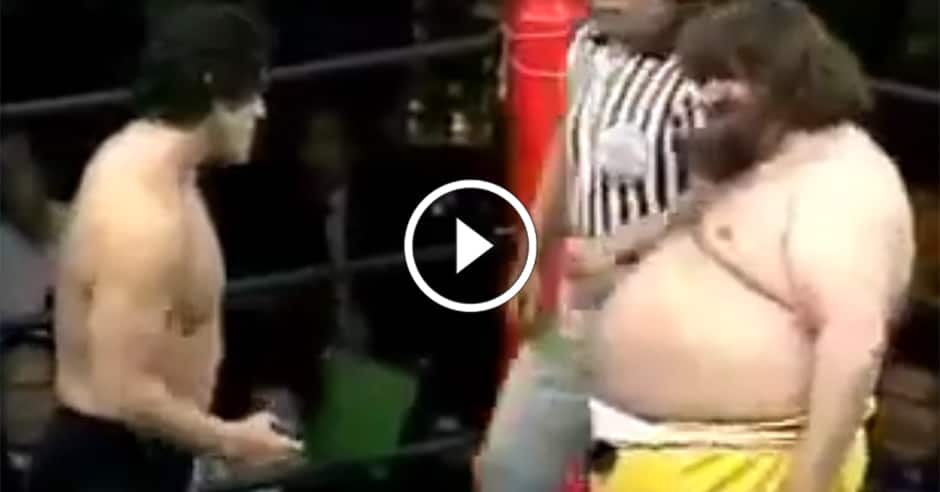
Antonio Inoki vs. The Great Antonio (real name Anton Barichievich)
December 8, 1977
Barichievich inexplicably stopped selling Inoki’s attacks and then struck Inoki repeated on the back of the head and neck. Inoki was trained in the art of hooking and shooting by Karl Gotch, and as such knew how to fight back. The match turned into a shoot (4:28 mark).
As is so often the case in life, the story does not have an entirely happy ending.
The Great Antonio ended his days destitute, homeless, hirsute, and illiterate on the streets of Montreal.

In a brighter circumstance, today Inoki is the best known figure in the Japanese pro wrestling scene, promotes MMA and pro wrestling events, and is a member of Japan’s Upper House. He also converted to Islam in 1990, and discretely changed his name to Muhammad Hussain Inoki.