This article is one small part of a long effort by MixedMartialArts.com to understand what works in martial arts. The primary focus is on what happens on the street, or in this case during a dojo storm, rather than in the arena. If you enjoyed it, check out the library on:
•Dojo Storms
•Martial Arts on The Street
•Style vs. Style
The sport of mixed martial arts was introduced to the world on a cold evening in Denver, Colorado on November 12, 1993, and called the Ultimate Fighting Championship. The goals were simple: to answer the question of which martial art is most effective, and to find the planet’s human apex predator.
Fast forward a generation and we now have a sport that jockeys for top position in popularity in many countries. However, the sport evolved from challenge fights and dojo storms in Brazil
Pioneers of Brazilian Jiu-Jitsu, the Gracie family had been issuing challenges to all comers for many decades before the art became widely known. Carlos Gracie opened the first martial arts academy in 1925 and for marketing, took out an ad in the local paper that read: If you want your face smashed, your backside kicked, and your arms broken, talk to Carlos Gracie at this address …
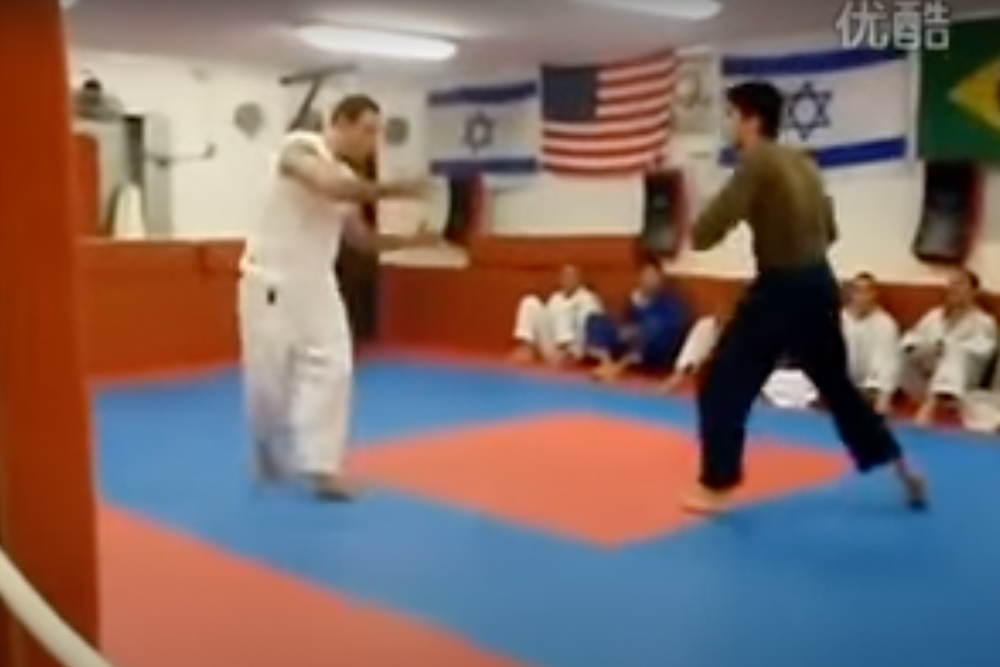
While the sport has grown remarkably, the practice of challenge fights and dojo storms still survives, here and there. Royce Gracie black belt Roy Peretz from Israel was challenged to fight with no gloves by a karate black belt.
This is what happened:
Not Respecting The Tap
There has been intense criticism of the jiu-jitsu black belt for not stopping when the black belt was caught in a rear naked choke and tapped. However, while it is true that in training you must respect the tap, this was a challenge fight.
As Rickson Gracie put it: “If we fight for money, I’ll stop hitting you when you ask me to. If we fight for honor, I’ll stop hitting you when I feel like it.”
And Peretz wasn’t even hitting the karate man. The submission was not a joint lock, the full application of which inevitably leads to a hospital visit. It was a choke, and when the man went out, the point had been made, emphatically, and the instructor immediately revived him.
Obviously, if there had been some prior arrangement to respect the tap and that was violated, then it’s wrong. However, it’s not safe to enter someone’s academy, challenge them to a bareknuckle fight, and then assume that tapping matters.
Does Size Matter?
Helio Gracie, Carlos Gracie’s brother, was as a young man small and frail, which put him at a major disadvantage when it came to combat sports. Therefore if he wanted to be competitive, he needed a new approach. What he figured out revolutionized martial arts: technique and leverage can overcome any size and strength.
What Helio developed was a method of utilizing technique and various leverage points to nullify his opponent’s strength and size advantage. This refinement of Judo, Catch Wrestling, and whatever else Mitsuyo Maeda picked up became the basis of what Helio’s son Rorion popularized as Gracie Jiu-Jitsu.
Note: Neither www.mixedmartialarts.com nor the author promote street fighting or physical acts of violence in any form or fashion. However; we wholeheartedly support the advancement of one’s knowledge and ability to protect oneself, as well as those around us.