It’s never a good idea to cause trouble when you’re out on the street. Especially these days with many people carrying guns and or other weapons. You also never know what the person you’re causing trouble with has for weapons, or skills.
In this case it’s lucky for the aggressor that his victim wasn’t carrying a gun or blade. But he was carrying enough to protect himself that night.
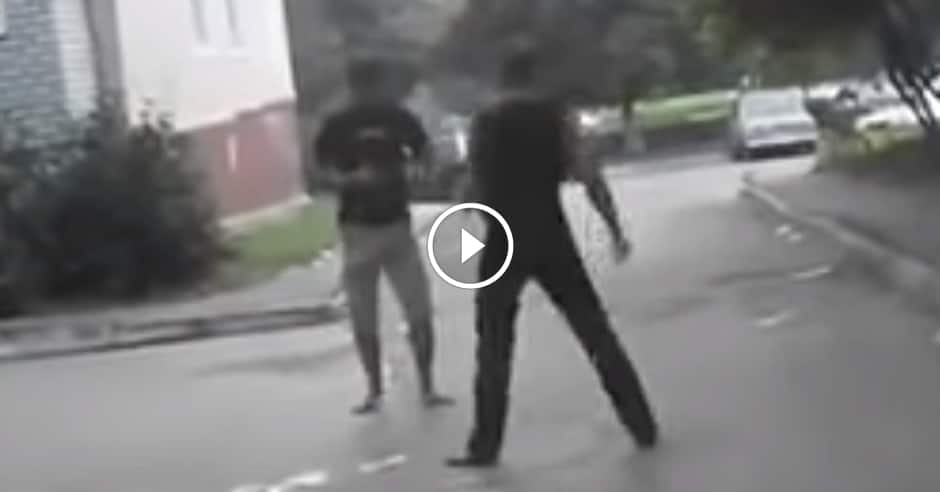
When the video starts, two men can be seen arguing. You can assume that the aggressor in this video is the one with his face blurred out, as he is the one moving forward and the one who throws the first strike.

Once that first strike is thrown, and missed, the victim takes a step back, gauges the distance, and let’s go of a vicious kick to the head that sends his attacker to the ground like a sack of potatoes.
Taekwondo is characterized by its emphasis on head-height kicks, jumping and spinning kicks, and fast kicking techniques, much like the one you saw in the video above.
In fact, World Taekwondo Federation sparring competitions award additional points for strikes that incorporate jumping and spinning kicks. To facilitate fast, turning kicks, taekwondo generally adopts stances that are narrower and hence less-stable than the broader, wide stances used by martial arts such as karate.
The tradeoff of decreased stability is believed to be worth the commensurate increase in agility, particularly in Kukkiwon-style taekwondo. Seems like it was worth it in this instance.
The emphasis on speed and agility is a defining characteristic of taekwondo and has its origins in analyses undertaken by Choi Hong Hi. The results of that analysis are known by ITF practitioners as Choi’s Theory of Power.
The components of the Theory of Power include:
Reaction Force – the principle that as the striking limb is brought forward, other parts of the body should be brought backward in order to provide more power to the striking limb. As an example, if the right leg is brought forward in a roundhouse kick, the right arm is brought backward to provide the reaction force.
Concentration – the principle of bringing as many muscles as possible to bear on a strike, concentrating the area of impact into as small an area as possible.
Equilibrium – maintaining a correct center-of-balance throughout a technique.
Breath Control – the idea that during a strike one should exhale, with the exhalation concluding at the moment of impact.
Mass – the principle of bringing as much of the body to bear on a strike as possible; again using the turning kick as an example, the idea would be to rotate the hip as well as the leg during the kick in order to take advantage of the hip’s additional mass in terms of providing power to the kick.
Speed – as previously noted, the speed of execution of a technique in taekwondo is deemed to be even more important than mass in terms of providing power. [source : wiki]