In the 1990s, after the downfall of the Soviet Union, many young men joined gangs looking for a livelihood and safety as well, but there is a psychological aspect in this matter: they are in search for identity, with an urge to engage in a purpose of life.
According to Svetlana Stephenson¹, Russian anthropologists has shown that organized fights in villages between groups of young men existed until the 1960s, where those people used to defend their neighborhood, street or community. Following particular rules, such as not hit someone when on the ground and there would not be any kind of violence against women, children or elderly. It was a display of strength and solidarity between groups.

The urbanization process in Russia brought some implications to the territorial fights: they became frequently among young men, for many different reasons. Those can be a revenge fight, a duel, a dispute settlement or even to test their strength, all of this in the form of an organized combat with distinct rules.
In this context of arranged combats, there is also the hooliganism (khuliganstvo) fights. From the 1970s, were the first hooligans of the country, represented by supporters of the two major teams, the Ukrainian side; Dynamo Kiev and Russia’s Spartak Moscow began one of the biggest rivalries in European football, which inaugurated the crowd fights on USSR.
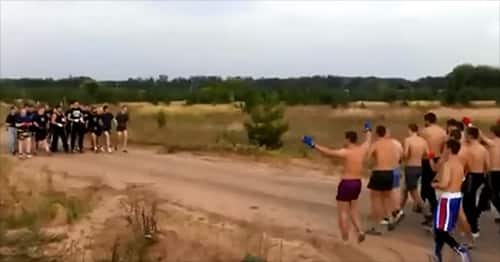
Soccer hooliganism normally involves conflict between gangs in Russia. Most of the brawls are set on the streets, but they engaged in brutal turf fights as well. Some rules have been spread among European hooligans’ groups, like a codex for behavior on and outside stadium.
For instance, those rules stated that an arranged fight with enemy group can only start with the same number of people in each side or an approximate amount. People who fall on the ground must not be attacked, only if he is able to continue to fight. They also cannot hit visibly injured people or those who gave up. In addition, they must have a mutual agreement about the rules before fighting starts. The majority of the hooligan groups in Russia officially support this system.