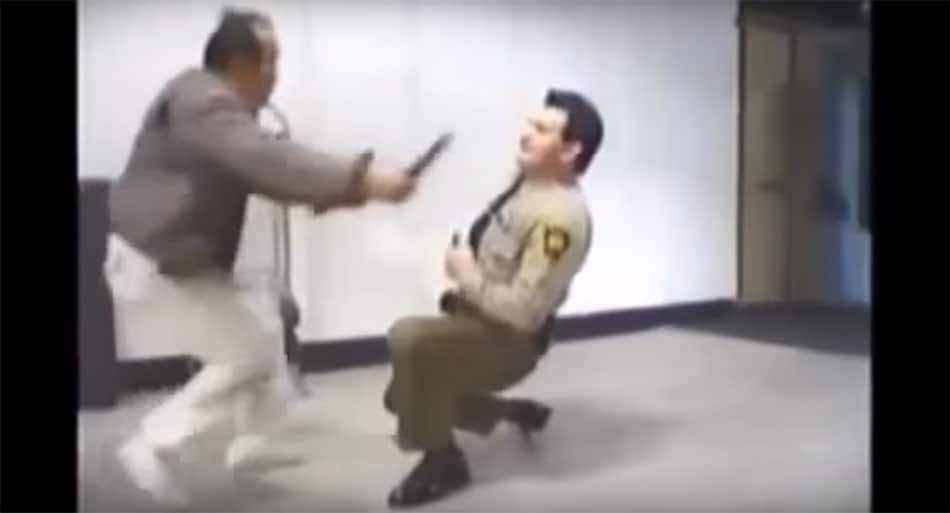
Common sense would indicate that gun > knife > fists. However, it is not that simple. Simple possession of a firearm alone is not necessarily sufficient defense against an edged weapon.
In the early 80s, Sergeant Dennis Tueller, of the Salt Lake City, Utah Police Department conducted a series of experiments. He learned how long it took an officer to:
•Recognize a threat;
•Draw a firearm;
•Hit center mass twice.
The answer was 1.5 seconds.
Then he determined how far someone with a knife could cover in 1.5 seconds. The answer was 21 feet.
Thus, a LEO with a holstered sidearm is in danger if he is within 21 feet of a potential attacker armed with an edged weapon. For three decades this 21-Foot Rule has been a central aspect of teaching law enforcement officers to defend themselves against edged weapons. In brief, if a suspect is armed with an edged weapon, and is within 21 feet, then the LEO should have his firearm out and aimed.
There is a commonly held belief that if you are carrying a gun, you do not need self-defense skills. Experience and research have shown this to be false.
Policeone.com did an extended two-part series on the development of the 21 Foot Rule by the Force Science Research Center at Minnesota State University-Mankato, excerpted below.
The FCRC has reached these conclusions, according to Executive Director Dr. Bill Lewinski:
1. Because of a prevalent misinterpretation, the 21-Foot Rule has been dangerously corrupted.
2. When properly understood, the 21-Foot Rule is still valid in certain limited circumstances.
3. For many officers and situations, a 21-foot reactionary gap is not sufficient.
4. The weapon that officers often think they can depend on to defeat knife attacks can’t be relied upon to protect them in many cases.
5. Training in edged-weapon defense should by no means be abandoned.
1. Because of a prevalent misinterpretation, the 21-Foot Rule has been dangerously corrupted.
Some officers and apparently some trainers have come to believe that the Rule means that a subject brandishing an edged weapon when positioned at any distance less than 21 feet from an officer can justifiably be shot…
“However widespread that contaminated interpretation may be, it is NOT accurate. A suspect with a knife within 21 feet of an officer is POTENTIALLY a deadly threat. He does warrant getting your gun out and ready. But he cannot be considered an actual threat justifying deadly force until he takes the first overt action in furtherance of intention–like starting to rush or lunge toward the officer with intent to do harm. Even then there may be factors besides distance that influence a force decision.
“So long as a subject is stationary or moving around but not advancing or giving any indication he’s about to charge, it clearly is not legally justified to use lethal force against him. Officers who do shoot in those circumstances may find themselves subject to disciplinary action, civil suits or even criminal charges.”
2. When properly understood, the 21-Foot Rule is still valid in certain limited circumstances.
In real-world encounters, many variables affect time, which is the key component of the 21-Foot Rule. What are the training skills and stress levels of the officer? How fast and agile is he? How alert is he to preliminary cues to aggressive movement? How agile and fast is the suspect? And so on.
These factors and others can impact the validity of the 21-Foot Rule because they affect an attacking suspect’s speed in reaching the officer, and the officer’s speed in reacting to the threatening charge.
Bottom line: Within a 21-foot perimeter, most officers dealing with most edged-weapon suspects are at a decided – perhaps fatal – disadvantage if the suspect launches a sudden charge intent on harming them. “Certainly it is not safe to have your gun in your holster at this distance,” Lewinski says…
3. For many officers and situations, a 21-foot reactionary gap is not sufficient.
Among other police instructors, John Delgado, retired training officer for the Miami-Dade (FL) PD, has extended the 21-Foot Rule to 30 feet. “Twenty-one feet doesn’t really give many officers time to get their gun out and fire accurately,” he says. “Higher-security holsters complicate the situation, for one thing. Some manufacturers recommend 3,000 pulls to develop proficiency with a holster. Most cops don’t do that, so it takes them longer to get their gun out than what’s ideal. Also shooting proficiency tends to deteriorate under stress. Their initial rounds may not even hit.”
Beyond that, there’s the well-established fact that a suspect often can keep going from momentum, adrenalin, chemicals, and sheer determination, even after being shot.
That’s one reason why tactical distractions, should play an important role in defeating an edged-weapon attack, even when you are able to shoot to defend yourself.
4. The weapon that officers often think they can depend on to defeat knife attacks can’t be relied upon to protect them in many cases.
Relying on OC or a Taser for defeating a charging suspect is probably a serious mistake.
With fast, on-rushing movement, “there’s a real chance of not hitting the subject effectively and of not having sufficient time” for the electrical charge–or for a blast of OC–to take effect before he is on you, says Gary Klugiewicz, a leading edged-weapon instructor and a member of FSRC’s National Advisory Board
Smug remarks about offenders foolishly “bringing a knife to a gunfight” betray dangerous thinking about the ultimate force option, too. Some officers are cockily confident they’ll defeat any sharp-edged threat because they carry a superior weapon: their service sidearm. This belief may be subtly reinforced by fixating on distances of 21 or 30 feet as if this is the typical reaction space you’ll have in an edged-weapon encounter.
The truth is that where edged-weapon attacks are concerned, “close-up confrontations are actually the norm,” points out Sgt. Craig Stapp, a firearms trainer with the Tempe (AZ) P.D. and a member of FSRC’s Technical Advisory Board. “A suspect who knows how to effectively deploy a knife can be extremely dangerous in these circumstances. Even those who are not highly trained can be deadly, given the close proximity of the contact, the injury knives are capable of, and the time it takes officers to process and react to an assault.
“At close distances, standing still and drawing are usually not the best tactics to employ and may not even be possible.” At a distance of 10 feet, a subject is less than half a second away from making the first cut on an officer, Lewinski’s research shows. Therefore, rather than relying on a holstered gun, officers must be trained in hands-on techniques to deflect or delay the use of the knife, to control it and/or to remove it from the attacker’s grasp, or to buy time to get their gun out. These methods have to be simple enough to be learned by the average officer.
Two techniques that bear reinforcement are illustrated in the well-known training video “Surviving Edged Weapons”, for which Gary Klugiewicz was a technical consultant. One is a deflection technique called Sweep and Disengage. The other is a tactic for controlling the attacker’s weapon hand, called by the acronym G.U.N. (Grab…Undo…Neutralize).
Stapp strongly believes that training in edged-weapon defense should prepare an officer to deal psychologically with getting cut or stabbed, a realistic probability with lag time, close encounters and desperate control attempts. “Officers need to be trained to continue to fight,” Stapp says. “They will not have time to stop and assess how severe the wound is. You don’t want them in the mindset, ‘I’ve been cut, I’m going to die.’ They must remain focused on stopping the attack, taking out the guy who is the threat to them.”
5. Training in edged-weapon defense should by no means be abandoned.
“Assuming it is presented accurately and in context with the many variables that shape knife encounters, the 21-Foot Rule can be a valuable training aid,” Lewinski says. “As a role-playing exercise, it provides a dramatic and memorable demonstration of how fast an offender can close distance, and it can motivate officers to improve their performance skills.”
Don’t forget, though, that most edged-weapon attacks are “up close and personal.” That means training must include effective empty-hand-control techniques, close quarters shooting drills and weapon retention. “We need to develop the ability to draw our sidearm, get on target and GET HITS extremely fast,” while moving as a diversionary measure if possible, says Stapp. “Close-range shooting–under 10 feet–will most effectively be accomplished when an officer has developed the ability to get on target ‘by feel,’ without using his sights.”
“Given today’s environment, rather than draw back on edged-weapon training, officers and agencies should be expanding it,” Lewinski declares. “Edged-weapon attacks are serious and should be taken seriously by trainers, officers and administrators alike. Finding out what works best in the way of realistic tactical defenses and then training those tactics as broadly as possible has never been more needed.”