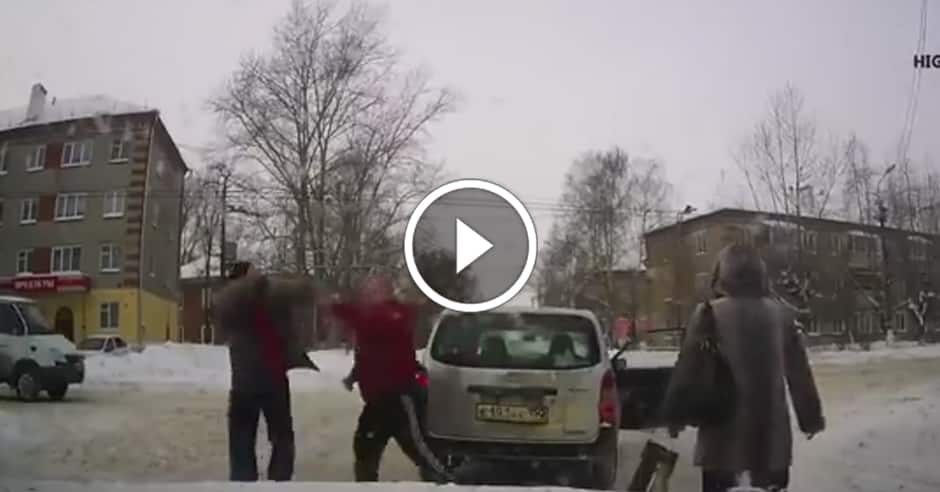
This footage from a dashcam in Russia does not begin unexpectedly. A car is driving down a snow road – check. A fight can be seen in the distance – check. A child’s voice can be heard in the car – check.
As the car pulls up to the fracas, things escalate. The track suit clad gentlemen exchange punches and kicks, as a woman walks by, pretty disinterested. The larger man, in red, lands a clean punch, drives the other the far side of the road, and throws him to the ground, where the struggle continues, with the man on bottom rising to standing.
In short, things are pretty normal for Russian dashcam footage. Then the unexpected happens.
The pair then get back into the car, close the doors, start it up, and drive off together, their differences apparently resolved.
You may ask yourself why fights are always breaking out within view of a dashcam, meteors streak across the sky, and tractor trailers slide off the road in Russia. It is not that those things are necessarily more common, it is that dashcam are ubiquitous.
Almost everyone in Russia has a dash-mounted video camera in their car.
The sheer size of the country, combined with lax — and often corrupt — law enforcement, and a legal system that rarely favors first-hand accounts of traffic collisions has made dash cams all but a requirement for motorists.
You can get into your car without your pants on, but never get into a car without a dash cam, Aleksei Dozorov, a motorists’ rights activist in Russia told Radio Free Europe last year.
Do a search for Russia dash cam crash in YouTube — or even better, Yandex.ru, the county’s equivalent of Google — and you’ll find thousands of videos showing massive crashes, close calls and attempts at insurance fraud by both other drivers and pedestrians. And Russian drivers are accident prone. With 35,972 road deaths in 2007 (the latest stats available from the World Health Organization), Russia averages 25.2 traffic fatalities per 100,000 people. The U.S., by comparison, had 13.9 road deaths per 100,000 people in the same year, despite having six times more cars.
A combination of inexpensive cameras, flash memory and regulations passed by the Interior Ministry in 2009 that removed any legal hurdles for in-dash cameras has made it easy and cheap for drivers to install the equipment.
And it’s turned into an online phenomenon.
Source: Wired