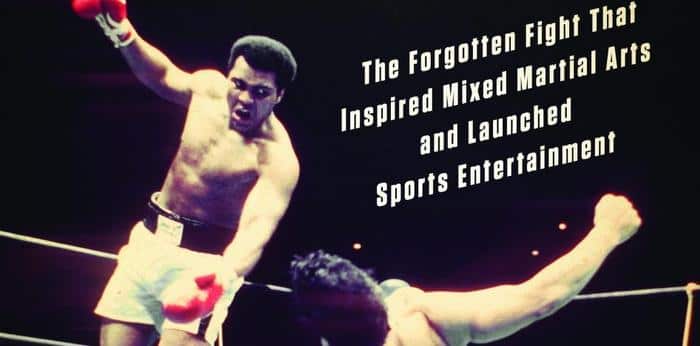
Two long, long, longtime pillars of the MMA media, Josh Gross and Bobby Razak, appear in this week’s Newsweek. On the 21st, Gross published Ali vs. Inoki: The Forgotten Fight That Inspired Mixed Martial Arts and Launched Sports Entertainment, and wrote an article for Newsweek about the book.
The article drew images and text from Bobby Razak‘s History of MMA.
Most Americans who watched Muhammad Ali take on Antonio Inoki, thought the bout was a strange spectacle. They were wrong.
BOBBY RAZAK, THE HISTORY OF MMA®
In spite of rules designed to protect Ali and defang Inoki, this was a legitimate contest. Inoki, for instance, wasn’t allowed to kick while he stood and Ali could gain his freedom from a submission if he simply touched a rope.
BOBBY RAZAK, THE HISTORY OF MMA®
Ali once confided in his longtime adviser and friend Gene Kilroy that fighting Inoki could lead to similar bouts in the future. He was right. Ali and Inoki weren’t the first fighters take part in a hybrid bout. But their match inspired a generation of fighters and promoters to create mixed martial arts as we know it today.
BOBBY RAZAK, THE HISTORY OF MMA®
—
40 years later, Ali versus Inoki signifies more than a sad money grab. The odd match brought together the worlds of professional wrestling and combat sports and led to the rise of modern mixed martial arts in a way few people could have expected.
Ali once confided in his longtime adviser and friend Gene Kilroy that fighting Inoki could lead to similar bouts in the future. He was right. Ali and Inoki weren’t the first fighters to take part in a hybrid bout. But their match inspired a generation of fighters and promoters to create MMA as we know it today. They made the path for other people to follow, says Gene LeBell, a legendary martial artist who won the first televised mixed-match in America in 1963 and later served as the referee for Ali’s contest with Inoki. And that’s what’s happening.
Several years after the bout, in the early 1980s, a group of promoters tried to create the first American MMA league in Pennsylvania. The attempt was short-lived as the state became the first to ban matches that mixed boxing with grappling. Meanwhile, in Japan, disciples of Inoki sought to prove that wrestling and submissions could work in a real fight; they organized mixed-fighting entities during the late ’80s and early ’90s.
When the Ultimate Fighting Championship (UFC) was created in 1993, its organizers didn’t want the bouts to be plagued by the onerous rule set that hampered the action between Ali and Inoki. Instead, the early cards listed only eye gouging and biting as fouls. These bouts proved violent and controversial and marked the sport’s rough beginnings in America.
Today, MMA is a mainstream sport with a global audience. Top-tier competitors are required to train in multiple disciplines and step into fights well-versed in every aspect of martial arts, from kickboxing to grappling. And though current bouts are generally more exhilarating than Ali’s and Inoki’s somewhat awkward affair, none of it might have been possible without the two men who bravely stepped into the ring that night.