This article is part of a larger effort by MixedMartialArts.com to understand what martial arts techniques and approaches work best, not by looking at bouts in the arena, but by looking at what happens outside the arena, on the streets, or in this case, in the gym. Check out more free, Best Of stories on:
• Style vs. Style
• Martial Arts on The Street
• Mutual Combat
The birth of modern mixed martial arts was inspired by an old, old question: What martial art works best? The answer is as simple as wheels on luggage – have experts of the different arts fight. The UFC has since evolved into a $10 billion sports entertainment empire, but the effort to find out what works via pitting exponents of different arts against each other continues.
In the video below from mother Russia, we see an Okinawan karate specialist taking on a muay Thai fighter. Neither is a master of the craft. The muay Thai boxer, who frankly speaking appears to be more of a kickboxer, is said to have been a silver medalist at the Moscow Muay Thai Championship, an amateur event. The karate man is a blue belt, indicating he has trained hard for perhaps three years.
Complaints about the level of expertise exhibited by the participants are misguided. What should be applauded is their willingness to test their art, with no gloves, and no rules.
What happened
As soon as the match begins we see a Thai low kick land hard on the karate man’s leg. The blue belt returns fire with a shuffle side kick to his opponent’s body, driving him back a little. The low kick probably hurt quite a bit more.
Surprisingly the karate fighter rushes in and grabs the Thai fighter, either to clinch up or to take him down. Neither technique is often seen in karate competitions. Standing clinching is not necessarily a wise idea against a Thai specialist, as the clinch is one of the most devastating aspects of the art. However, in attempting a takedown, Thai rules prohibit the attacking player’s leg from going behind the opponent’s leg.
The karate fighter eventually takes his opponent down with osoto gari, an outer reap, which would be prohibited under muay Thai rules. On the ground, the karate blue belt pulls a couple of powerful punches, letting his opponent know he could have won there.
The karate fighter lands a decent spinning back kick; it’s perhaps the best strike of the match so far. The muay Thai guy looks to be slowing down at this point, with the momentum starting to go the karateka’s way. A karate lunge punch lands when his opponent rushes in.
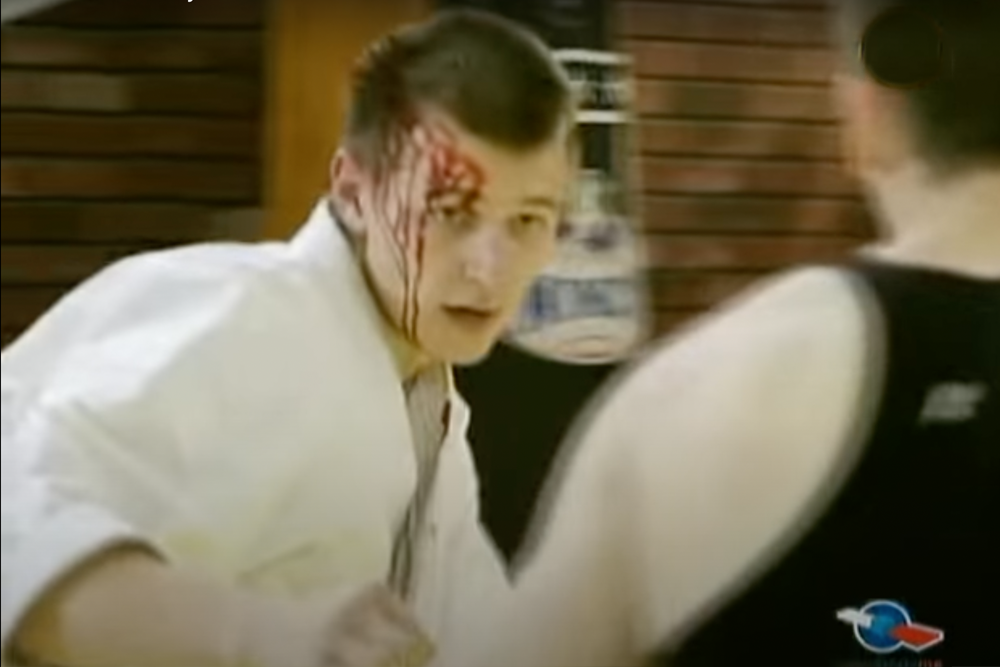
The karate guy is throwing a lot of head kicks, none of which are significantly landing. However, they are putting his opponent on the defense. The Thai fighter rushes in with a flurry, which temporarily sends his opponent to the ground; it could have been a slip. There is a lot of blood coming from the karate guy towards the end, likely from that last flurry.
The match ends when the karate guy gets the muay Thai exponent down again, this time with a double leg takedown, pulls another punch that would have devastated had it landed, and is then declared the winner.
What’s the lesson?
The most obvious lesson here is that in trying to determine which is better, muay Thai or Okinawan karate, the clear answer is wrestling. Wrestling is the single most important aspect of mixed martial arts, as wrestling technique allows one to take the fight or keep the fight wherever one wants.
But even more important than that is the brave, open-minded attitude of the Russian fighters and their coaches, to find out what works by testing for real. That is the true spirit of mixed martial arts.
Share your thoughts on The StreetGround forum at MixedMartialArts.com.