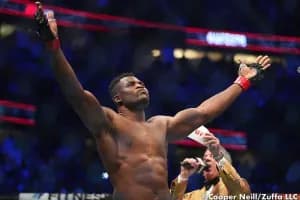
Dana White opened his post-fight press conference with the figures and did not whisper them.
“The gate was 6.7 million. The attendance was 19,238. Sold out,” White said. “We shattered the arena record by $2 million.”
He then made the point the numbers were built to carry, in his own unvarnished phrasing: “We’re in Philadelphia, Pennsylvania with a Russian Muslim and an Irish kid, and we do a $7 million gate and we shatter the f*****g record here.” The framing is blunt but the observation underneath it is the business story. Neither Islam Makhachev nor Ian Machado Garry has roots in Philadelphia or the surrounding region. The card carried no hometown headliner, no local rivalry, no regional hook beyond a seven-year absence and two title fights. It sold out anyway, at record prices.
The raw numbers matter for a specific reason. Live gate is one of the few revenue lines the promotion discloses with any regularity, and it functions as a public proxy for the health of the touring business. Media rights sit behind contractual walls; ticket revenue, once announced, is checkable against capacity and pricing. The UFC 330 figure works out to an average paid ticket of roughly $349 before fees, which places the card in the upper band of North American combat sports events this year. And the streaming-era comparison is the sharpest available context: UFC 323 last December, the promotion’s final event under the old pay-per-view model, drew 18,603 fans and $4.7 million at T-Mobile Arena in Las Vegas, the sport’s most reliable gate market. Philadelphia, off a seven-year absence, beat the promotion’s last PPV-era Vegas number by two million dollars. Whatever the Paramount+ transition has changed about how fights reach screens, the in-building business is not shrinking.
The venue context sharpens it further. The Xfinity Mobile Arena, the renamed Wells Fargo Center, hosts the 76ers and Flyers and has absorbed record-setting concert tours through 2024 and 2025. Combat sports gates in the building have historically trailed those touring benchmarks, though the city gave notice of its appetite in 2025 when BKFC sold out the same room for KnuckleMania. Saturday confirmed the thesis at the sport’s top tier: Philadelphia is a combat sports town that the sport’s biggest promotion had, for seven years, simply not visited. Local color underlined the point. Pennsylvania Governor Josh Shapiro was in the building, Comcast Spectacor’s leadership presented White with a Flyers jersey, and per Crossing Broad’s account from inside the arena, fans were lining up more than an hour before the early prelims began. The octagon’s smaller floor footprint let the promotion sell floor seating beyond a typical Sixers or Flyers configuration, which is how a 19,238 figure emerges from the building at all.
The city also got a night worth the wait. Twelve fights, two title defences, Makhachev’s record seventeenth straight win, and a hometown moment when Philadelphia’s own Jeremiah Wells finished heavy favourite Myktybek Orolbai on the prelims, the local win the card technically lacked at the top delivered from the undercard instead.
The scheduling read is the part with consequences. Philadelphia has historically been approached with caution, wedged between New York, New Jersey, and the DC corridor on the promotion’s regional calendar, and the seven-year gap reflected that maths. A record gate without a local name on the marquee is the kind of data point that changes how a building gets pitched and how a corridor gets scheduled. This was only the promotion’s fourth visit to the city ever. On Saturday’s evidence, the next gap will be measured in months, not years.
For now, the number sits on the board. 19,238 tickets. $6,715,776. Both building records, set by a card with no local headliner, in a city the promotion had written out of its touring plans for most of a decade. The road show moves on to Sacramento’s Golden 1 Center on August 22. Philadelphia, seven years patient, finally got its night, and paid a record price for it happily.