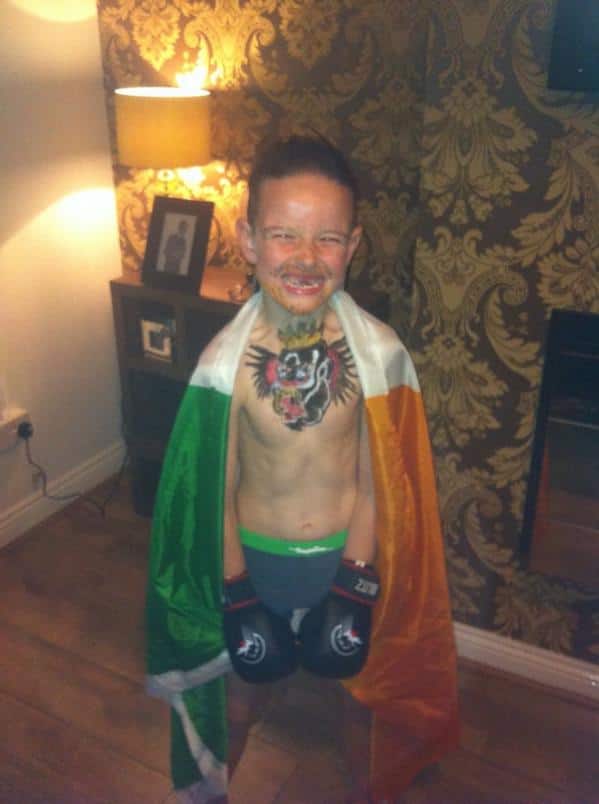
UFC unified featherweight Conor McGregor is an inspirational figure for countless millions, in his home country of Ireland, and worldwide. Among his fans are many children, and many of them are taking up martial arts.
McGregor is delighted/.
“There are many, many young kids who are seeing the path now,” explained McGregor. “There are many, many parents of young kids who are seeing my path, and encouraging the game of martial arts. And whether you put your child into martial arts or whatever, it allows them to go and conquer whatever they want to. Whether they want to conquer the fight game, they can. Whether they want to go and conquer the business game, or whatever route they decide to take, training the martial arts will help them.
“So I am happy that I have put martial arts in the spotlight in my country, and shown it for what it is. True dedication, and a beautiful discipline.”
McGregor with youth.

McGregor as a youth.


Youth who want to be McGregor 🙂


While the benefits for children of studying martial arts like Judo, Karate, and Brazilian Jiu-Jitsu, are widely understood, the benefits of wrestling are often overlooked. And in many school systems, it is free.
Matt Krumrie has the story for USA Wrestling.
Like many parents new to wrestling, Kelly Stettner of Springfield, Vermont once had questions and concerns about her then eight-year-old daughter, Moira, competing in a sport she literally knew nothing about. Would she be too weak to compete? Too small? Would she get injured? How would she handle competing against boys?
Fast forward seven years to 2014 and all those worries are gone. Her daughter, who likes to be called Mo, just finished fifth at the Vermont JV State Tournament. And as for Kelly, she went from anxious mom to a supportive team manager who loved getting on the edge of the mat to film her daughter’s matches.
“Wrestling has been just incredible for Mo on many levels,” says Stettner. “She tried soccer, softball, even field hockey and basketball before giving wrestling a shot. Wrestling is Mo’s stress release and an opportunity for her to challenge herself physically as well as mentally, while having fun.
“Wrestling builds character,” says Lennie Zalesky, former ALL American under Dan Gable, who is now the head coach of the California Baptist University wrestling team. “It teaches your child how to develop discipline and a work ethic that is difficult to find in any other sport. It is a sport that leaves a permanent chapter on one’s soul.”
“I’ve coached for a long time and I have met so many people that, though successful in their professions, would rather talk about their wrestling days than what they are doing or other successes they have made. The sport makes even the average wrestler proud of his accomplishments, proud that he made it through practices, took down one of the best kids in the room and made the weight for the weight class which he wrestles. The list of these self-accomplishments can be very long. I rarely meet a man that does not cherish his days competing as a wrestler.”
Safety is often a concern of parents unfamiliar with the sport, says Clarence Long, Head Coach of the Hustle & Muscle Mat Club, a USA Wrestling certified youth wrestling club and nonprofit organization based in Washington, D.C. “Wrestling coaches and referees understand that there are risks to a child’s physical safety and are constantly monitoring practices or matches for situations that could harm a wrestler,” he points out.
To get started all you need are wrestling shoes, headgear, a singlet, and some workout attire such as shorts and a t-shirt. There may be club and membership fees, but Long says many youth wrestlers can compete a whole season for $200 or less. His club has 40 members that spent a combined $6,500 to compete this past season. That’s just a little over $160 per person, a fairly low figure compared to many other equipment-intensive sports.
Those involved with wrestling often talk about the sport as a metaphor for life—teaching lessons that will be used off the mat. Youth WRESTLINC COACH Joe Reasbeck compares stepping out on to the mat as a chance to overcome the kind of fear some feel when public speaking, or going on an audition, or a job interview. It’s the type of fear you have when you’re pushing out of your comfort zone and challenging yourself , he says. But each time you face it, each time you step on the mat, you build your capacity to face other fears and that’s something invaluable that kids garner from wrestling.
WRESTLING MYTHS
Myth: Wrestling is unsafe
Wrestling rules are very clear on safety. Illegal moves and potentially dangerous situations can result in penalty points and even disqualification. Coaches and referees work very hard to keep wrestling safe for all participants.Myth: Wrestling is a brute sport
Wrestling is not a sport that demands brute strength. Technique and conditioning are more important to succeed in wrestling than the ability to push someone around the mat for 30 seconds.Myth: Wrestlers engage in unhealthy weight loss
Youth wrestling discourages so-called weight cutting. High school and collegiate athletes’ weight loss is now closely monitored by a tracking system developed by the National Wrestling Coaches Association (NWCA), which prevents a wrestler from dropping below 7% body fat or losing too much weight too quickly.WRESTLING BENEFITS”
•Wrestling provides a positive outlet for especially energetic boys and girls.
•Wrestling is an individual sport, but also has a team component, and still teaches teamwork and the importance of working together.
•It is one of the few sports where a child’s foot speed, ball-handling skills, hand-eye coordination, and size do not matter. There is room for everyone and wrestlers only compete against others in a similar weight class.
•Wrestling competitively is tough, but teaches empathy at a young age because sooner or later, everyone loses a match. How often do you see eight-year-old teammates hugging and consoling each other after emotional losses?