In 1993 Rorion Gracie ended generations of chatter about what the best martial art was. His idea was as simple as wheels on luggage – to find out what martial art works best, have exponents from each style fight each other.
The result was the UFC.
However, as characteristically happens with great human endeavors, there was multiple discovery.
In 1980, former Kyokushin karate practitioner Kazuyoshi Ishii, formed his own organization, Seidokaikan. In 1993, entirely independently of the UFC, Ishii launched K-1, a league to pit the best strikers in the world against each other.
The K in K-1 represents the words karate, kickboxing, kung fu, Kempo, Kakutogi (a catchall term of martial arts) and even TaeKwondo.
Ishii originally used Kyokushin rules, but gradually moved towards international rules kickboxing bouts. There were even early attempts that allowed punches to the face, but those were problematic for obvious reasons.
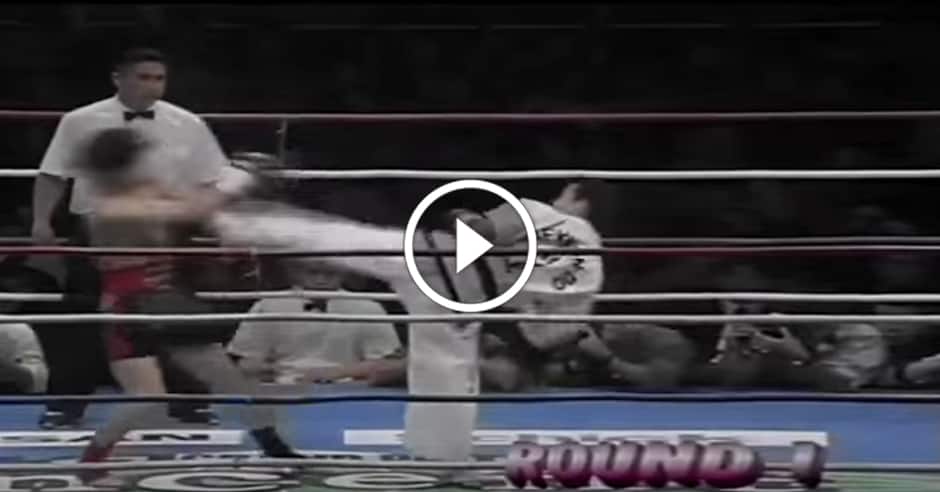
This fight between flyweights Isamu Hayami vs Takayuki Murosaki took place in 1996, in the finals of the K-1 Grand Prix. Murosaki was a Muay Thai fighter while Hayami was a top Japanese Taekwondo exponent, under the ITF rule set and traditions.
The fight is good, with both fighters showing many of the defining characteristics of their art. It should be noted that K-1 rules prohibit the extended clinching that is so integral a part of Muay Thai. Further, Murosaki would probably be far better described as a Japanese kickboxer who draws on elements of Muay Thai, rather than a Nak Muay. He doesn’t move, attack, or strategize like a Thai fighter, although he is billed as one, perhaps for marketing purposes.
Hayami was allowed to use his entire arsenal of Taekwondo moves, but may have had insufficient unfamiliarity with being punched in the face.
In the final analysis of course, styles don’t fight each other, people do. And the purpose of martial arts includes more than just fighting. So one kickboxer beating one Taekwondoman means nothing in a larger context in and of itself.
However, not all styles are identically equal in terms of effectiveness in a fight. In a mixed martial arts context, fighters draw from a wide variety of styles those techniques that best hold up against exponents of other fighting systems. You see a lot of Muay Thai in MMA; Tai Chi striking not so much. As Bruce Lee put it, Adapt what is useful, reject what is useless, and add what is specifically your own.