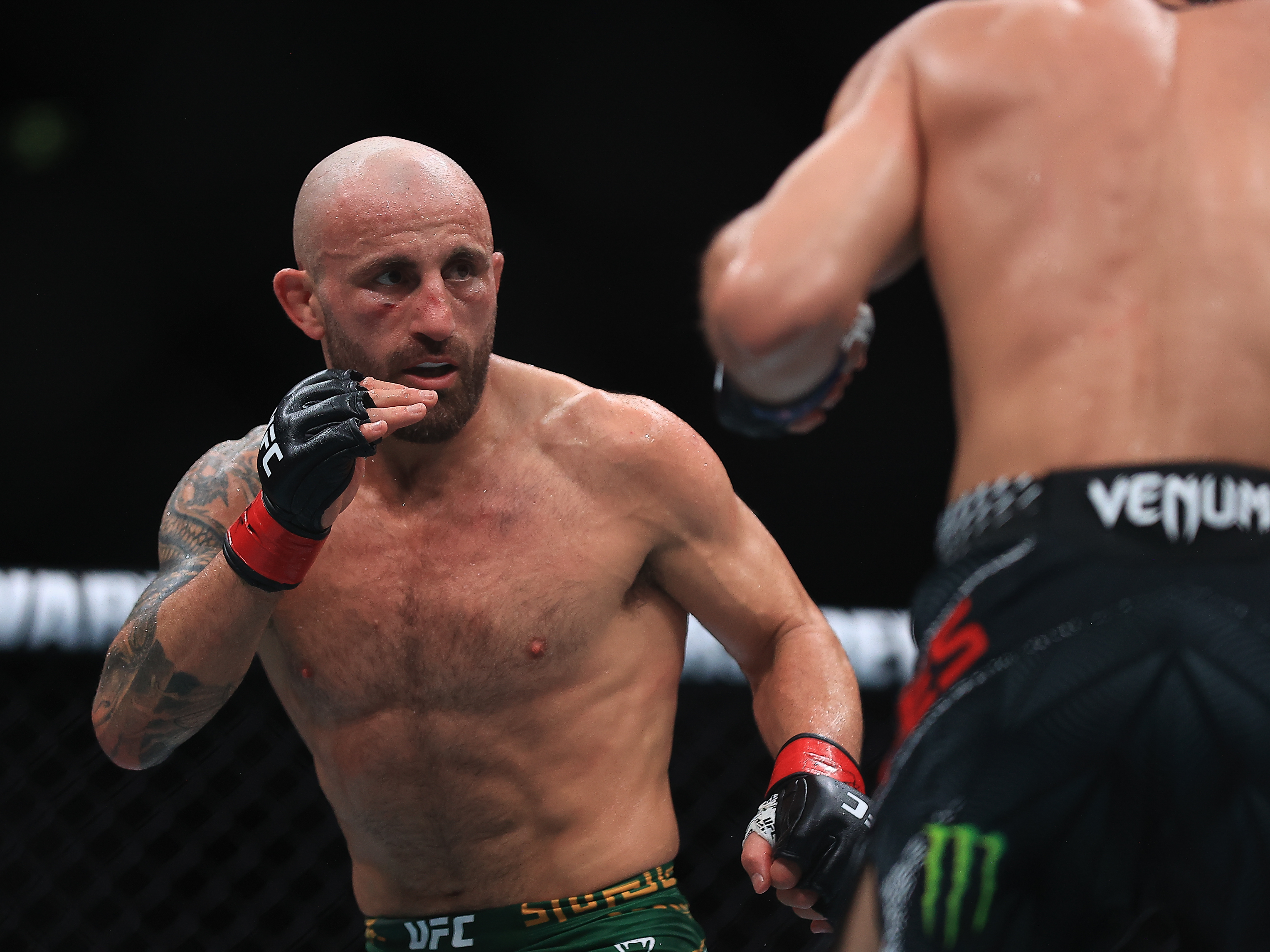
This past weekend during the UFC’s debut on ABC, Max Holloway had one of the best fights of his career. Against a game Calvin Kattar, Holloway landed 445 significant strikes, a UFC record. In fact, according to TSN’s Aaron Bronsteter, he landed more shots than Deiveson Figueiredo and Zhang Weili have landed in their careers.
It was the most one-sided bout in MMA history. Credit went to Holloway as it should, but many were praising Kattar for his resilience. Did he need to absorb that much damage, however? While referee Herb Dean could have stopped the fight, and many other bouts before this one, could there have been another force who could have stopped the fight?
The force being referenced is Kattar’s corner.
Cause for concern for Kattar
A fighter does not know when to give up, especially in high-profile bouts that can change their careers. They are tough as nails, which is a blessing and a curse. As blood was pouring down Kattar’s face from elbow shots and straight jabs, Kattar’s corner would not throw in the towel. Social media exploded with those worrying about his health.
UFC President Dana White even told reporters after the fight how concerned he was.
I thought the fight should have been stopped in the fourth round, White said, via MMA Fighting. I was freaking out a little bit. I said [to his coaches] he’s not going to stop and talk to anybody. We’re going to take him straight to the ambulance and send him to the hospital.
https://twitter.com/ufc/status/1350579112914644995
History of unease
This anomaly of corners staying put is not new to MMA, or combat sports in general. Back in May, Anthony Smith was in trouble against Glover Teixeira. It was a strong performance by Teixeira, who at one point took out several of Smith’s teeth. The former light heavyweight title contender in Smith would end up badly losing the fight. It was puzzling to see a corner not intervene.
Several corners and coaches were interviewed by ESPN and gave their views on determining when/if to end fights. American Top Team’s Mike Brown discussed the impact of potentially stopping a fight, from the fighter’s reaction to the stakes of the bout. It is a tough position to be in. SBG Ireland’s John Kavanagh gave an interesting response:
To put it succinctly: The time to throw in the towel is when you believe your fighter has no chance of winning.
The quote is fascinating as there are many cases where a fighter may have no shot at winning. Tony Ferguson lost a one-sided fight to Justin Gaethje at UFC 249, but his corner did not stop the fight. It was only after he finally fell that the referee saw enough. As much as fans praise Ferguson’s toughness, the amount of damage he has taken is concerning.
The coach is always right?
2020 has seen its fair share of questionable corner decisions.
The Nevada State Athletic Commission had to look into the team of Max Rohskopf following a fight against Austin Hubbard. Rohskopf fought Hubbard in a short-notice fight and was not doing well at all. On the TV broadcast, you can visibly hear Rohskopf pleading to his corner to end the fight. Robert Drysdale, Rohskopf’s head cornerman, however, would not stop it. It was not until an NSAC inspector reached out to the referee of the bout that it was called off.
https://twitter.com/SpinninBackfist/status/1274476052115488768
Speaking with ESPN, Drysdale had no regrets for the way he called the fight.
I stand by what I did, Drysdale stated. I expect excellence from the people I train because I love them… I felt he needed a mental push… That is the job of a coach, to push their fighters physically, technically, and mentally. I did my job, and I have no regrets because I believe Max has potential to be one of the greats.
Rohskopf has since been released from the UFC.
Thinking of the future
As tough as a fighter is, the long-term effects could be damaging. Mark Breland saved boxer Deontay Wilder when Tyson Fury dominated all aspects of their fight last February. Throwing in the towel, he was criticized by and fired by Wilder. Who knows where Wilder would be without him, though.
One of the most severe cases in combat sports is Maxim Dadashev, who died following injuries suffered in the ring. His corner tried to stop the fight, but the kid would not give in. When both sides can’t come to an agreement, chaos reigns.
This is not to say an MMA fighter, or Kattar is general, will not be back. There will be a concern, however, on his status mentally and physically.
Can anything be done?
Fighter safety has always been a top priority for any promotion. There will always be conflict when it comes to how long a fight should go, from the fighter, the corner, or the referee. In this case, the rational decision might have to overtake the nonsensical, old school method of fighting.
It may not be favorable for some, but down the line there may be those who thank the men/women who helped make their lives better before it got worse.