In 2007 UFC Hall of Famer Chuck Liddell lost the UFC light heavyweight championship to Rampage in May, dropped a Split Decision to Keith Jardine in September, and won the fight of the year vs. Wanderlei Silva in December. Then Liddell fought just once each in 2008, 2009, and 2010, losing each by KO.
His boss and close personal friend Dana White gave the fighter a no-show desk job in return for retiring. However, when WME-IMG bought the UFC, they cut costs, including White’s use of a corporate jet and a number of personnel including Liddell and fellow Hall of Famer Matt Hughes. Liddell had believed the position was for life.
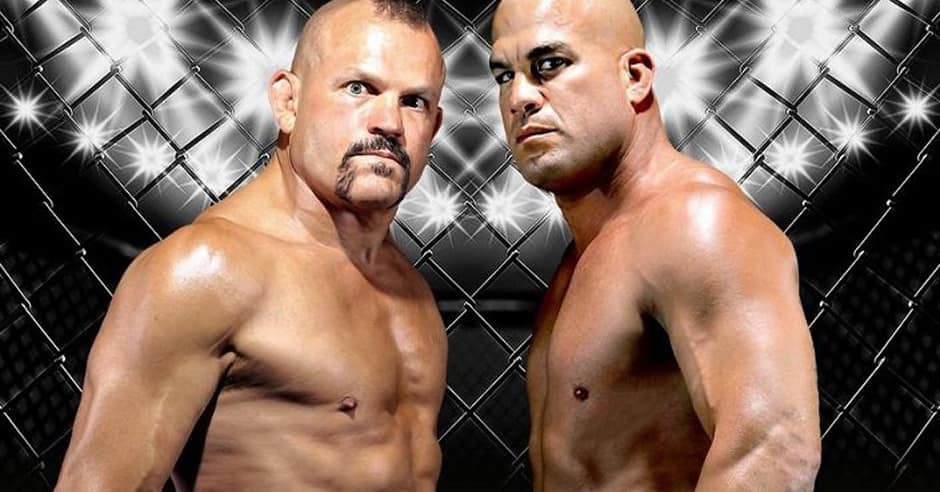
Now Liddell and fellow Hall of Famer Tito Ortiz have been licensed by the California State Athletic Commission (CSAC) to fight on November 24, in an event promoted by Oscar de la Hoya. During a recent appearance on Ariel Helwani’s MMA Show, Liddell talked about the long, strange trip.
“I wasn’t really ready to leave when I left,” said Liddell, as transcribed by Jeff Wagenheim for ESPN. “I love this sport. I love fighting. I love training. And I feel that I’ve still got some fight in me. Part of it is people told me I couldn’t. If you tell me I can’t do something, I like to prove to you that I can.”
“[Ortiz] keeps saying I’m a shell of the man I was [and] now he can beat me. Why would you even want to promote that? ‘The only reason I can beat you now is because you’re a shell of the man you used to be’?”
Liddell’s longtime trainer John Hackleman made it clear that he wishes Liddell didn’t fight, and that if he did, he’d be there in his corner.
“He has his opinion and we’ve spoken about it,” said Liddell. “And I made my decision and he understands it. He’s there for me.”
CSAC requires the additional medicals for fighters recommended for fighters 40+ by the Association of Ringside Physicians, which include:
•Blood work, including a complete metabolic panel and blood count;
•Brain MRA;
•Cardiac testing that provides both myocardial perfusion and echocardiographic structural assessment”;
•EKG;
•Ophthalmological eye exam with pupil dilation and retinal examination; and,
•Neuro-cognitive testing.
Part of the final one requires counting down a list of numbers in reverse order.
“I went through the whole list,” said Liddell. “Everyone forgets I was an accounting major. I’m good with numbers.”
And then there is money. The UFC gives points on a PPV, in the range of maybe 2.5. The deal with DLH is for the fighters to get a major percentage. If it does as well as a decent UFC card, they will make a killing. However, no one but the UFC does well with PPV, or they would be doing t.
“I’d like to do over 300,000,” said Liddell. “The chance at a home run, the chance at a big payday, is great.”
“It’s kind of cool doing this and getting back into it and how many people have come up to me and said I’ve inspired them to get back into doing something they love, or to go and start working hard at something, or to try something they didn’t think they could do. I am going to open a gym after this. I am going to stay in the sport, competing at least as a coach, if nothing else. This whole journey gets me back to my love of the sport, to being in and around the sport. I missed it.”
.