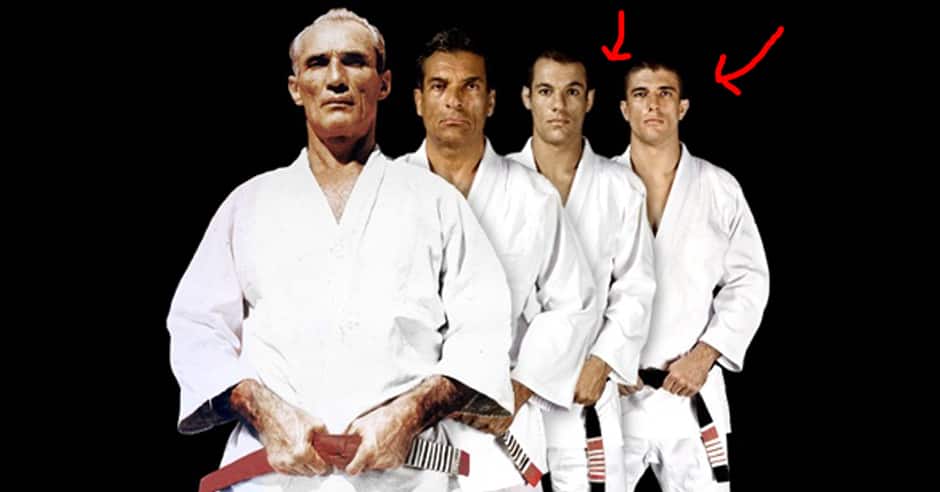
Helio Gracie refined Jiu-Jitsu, through experience in real fights. His son Rorion showed to the world this application of the scientific method to martial arts. His grandsons Rener and Ryron too are active in the field, but their contributions are very nearly the polar opposite of actual fighting. Their great innovation is distance learning via Gracie University.
In an interview with Tatame, Rener said that video learning it in fact a superior alternative to learning BJJ in an actual academy.
“Some people do not understand that online study is even more effective than learning in the traditional classroom,” said Rener, via Google Translate. “In a live class, there are students of all stripes, and the teacher gives the same lesson for everyone. Online, each has its specific class. Some people tried to learn in the classroom, but the lessons were random, and some students had difficulty learning. And what did they do? Resorted to Gracie University!”
Rener and Ryron are not paper tigers. They can fight, and train some of the top fighters in their divisions. Still, they are now figures of considerable controversy, and were recently subject to criticism from their uncle Royler, and from Robert Drysdale.
The two are not impressed with Gracie University.
Rener responded by detailing the success he is having with Gracie University. he thought it up when he was injured and could not train for 10 months. He said in December that Gracie University had 119,775 members. At $35 per month, that is a lot of revenue. But the wording is ambiguous. Is that 119,775 active members? That would be $4,000,000 per month. Is that 119.775 members that have tried it, including free trials?
The University originally awarded belts through brown via video. After pressure from the family, they now only award a blue belt via video. Subsequent belts have to be in person. That is still an absurdity to Drysdale, who is a gold medalist at the ADCC world championship and the Mundials, and is currently signed with the UFC.
Drysdale penned an open letter, published at Tatame.
The first Jiu-Jitsu gym I ever set foot in to train had a portrait on the wall of one of the most influential figures in the development of Jiu-Jitsu in Brazil wearing a blue belt. Helio Gracie was protesting what he considered to be the easy grading and downfall of Jiu-Jitsu standards. The picture that hung there served as both a reminder of the effort discipline and motivation required to pursue the journey and the high-standards its practitioners should uphold. I never had the opportunity to meet Helio, and although I do not believe in heroes or saints, I suppose it’s fair to say he was a tough man who saw himself as an ambassador and guardian of the art he dedicated his life to.
Jiu-Jitsu has changed dramatically since then. Leaving the technical advancements aside, perhaps the greatest change it has gone through is the over-commercialization, bordering on trivialization of what, above all, should serve as an educational device based on tough-love, commitment, discipline, and quality of technique. These are the lessons that enrich the journey and make Jiu-Jitsu the life tool that it is. The question is, can these lessons be learned off the mats, while lying in bed with a laptop computer? According to Rener and his brother Ryron, the answer is: yes, you can.
The followers of the Gracie University will never learn these hard lessons. All that is required of them is that they memorize a few moves, film them and send them over for approval. That is, assuming an expert is actually doing the approving over at the Gracie Academy. Whether they’re actually learning anything that resembles Jiu-Jitsu is a different matter altogether. For those of us who have earned our belts the hard way, Jiu-Jitsu is above all, about failure, defeat, and frustration followed by a strengthening of character required to rise above these challenges and come back stronger the next day. This strengthening of attitude is a far more important lesson than the technical value of Jiu-Jitsu as a martial art. They are the essence of Jiu-Jitsu as a life teacher for overcoming difficulty.
This is not to say that you can’t learn anything online. Ideas can be shared, perspectives created, and suggestions taken that can improve a skill set that is being developed inside a gym, mainly by the hard lessons of getting repeatedly beaten on the mats. It is, after all, inside the gym where all the real work takes place, like Helio did, through keen observation and lots of training while using trial and error to pursue perfection.
The problem lies not in the instruction itself, however difficult it may be for a beginner to verify its quality, but the lack of any selection process. Under this system, anyone with enough time and money on hand can become an expert. Never mind the actual knowledge, character, and discipline that cannot be learned or tested through a computer screen or on a cell phone.
Just imagine if other professions were all held to the same low standards of filming a video and emailing it to a professor, whom you’ve never met, for approval without ever having acquired any practical knowledge. Think of a doctor who has done all his learning online and has no practical experience whatsoever. Should that doctor be allowed to practice and operate on patients? If not, shouldn’t Jiu-Jitsu practitioners strive for similar standards? However more important the field of medicine may be, we shouldn’t trivialize the grading and promotion of an art like Jiu-Jitsu.
Another question that arises is the personal nature of Jiu-Jitsu. Perhaps it’s most endearing quality, is its adaptability to our own individual talents, abilities, and limitations, both mental and physical. This is all lost when a cookie-cutter approach to Jiu-Jitsu is being taught. With enough time and experience on the mats, students should develop a style that suits their pre-existing abilities and traits. To have an online system as your sole teacher without that practical knowledge and guidance of an expert is to cripple and limit the potential and uniqueness of your own Jiu-Jitsu. An online system can only serve as a guide; it cannot teach you these invaluable creative lessons.
To make matters worse, Rener tends to brag about the spike in sales on his website following the barrage of criticism his website has received from his own family and other true practitioners of the art. Make no mistake; Rener takes pride in promoting people through the internet. To which I can only reply that one should not underestimate the lack of critical thinking by people who have an immense appetite for quick rewards following no work at all. To make matters clear, no one here disputes the profitability of selling out, regardless of the industry you pursue. But that’s not what’s in question here. What’s in question is the future of the art and its standards.
It is also instructive, and certainly not a coincidence, that the grandchildren of the late Helio Gracie waited for his death to launch a global campaign of prostituting his legacy and that of his family. A legacy built on sweat, blood, and sacrifice. Something no one will ever be able to understand behind the ease and comfort of a computer. They insult not only the memory of their grandfather, but also the sacrifice and dedication of hundreds of thousands of practitioners worldwide who understand perfectly well the effort and discipline necessary for being awarded a mere blue belt. These practitioners, who can proudly say they live the Jiu-Jitsu lifestyle and who are the real heirs to a legacy, are all responsible for safeguarding the standards of the gentle art and have more than just a right to critique online belt gradings. They all have an obligation to discredit the Gracie University and it’s mockery of Jiu-Jitsu as a martial art. As practitioners we all bear some weight for maintaining and elevating these standards and continuing to make the road to a black belt ever more arduous. Helio would agree with us.
If someone promised to make you a competent swimmer by watching you wave your arms around on video, and charged you $35 a month, it would not get many takers. It is the sad nature of martial arts that claims that would get laughed at in any other conceivable field are given credibility, and $35 a month.
Bruce Lee famously said if you want to swim, you have to get into the water. The Gracie University students need to get to a legitimate academy, and roll with people at their belt, and see if they are comparable. If they roll and fail, and are told that is because the moves they are learning are for the “real world” and this is just mere sport, then Helio’s grandsons has fallen into the despicable pattern that martial arts schools have employed on suckers for generations – “these moves are so deadly that you can’t use them, so ignore all the people training for real in the rival gym.”
Or Gracie University may work well. But words alone will not prove it. Those days are dead, thanks to the Gracie family. It would be a tragedy if younger members of that same family tried to revive a time when all martial artists did to prove their effectiveness was talk.
Gracie University students need to actually try it. Hopefully they do well.