BATAIREACHT
Origin: Ireland
Description: When martial arts weapons are mentioned, nunchaku, staff, and tonfa readily come to mind. These were common tools in Okinawan that were developed into weapons when the Japanese authorities banned conventional weapons, in order to more ably control the population.
An identical process took place in Ireland. The English controlled weapons, so the Irish developed walking sticks into formidable instruments of destruction. Too, the Irish working class did not need oppressors to develop a method of self-defense with a club.
The style is called Bataireacht. Bata is an Irish term for a stick. The particular bata used in Bataireacht is the more familiar Shillelagh, which does not have a uniformly standard size. The stick is grabbed by the third, with the lower part protecting the elbow, and the upper 2/3 used for striking. This unique grip allows for fast punching-like strikes.
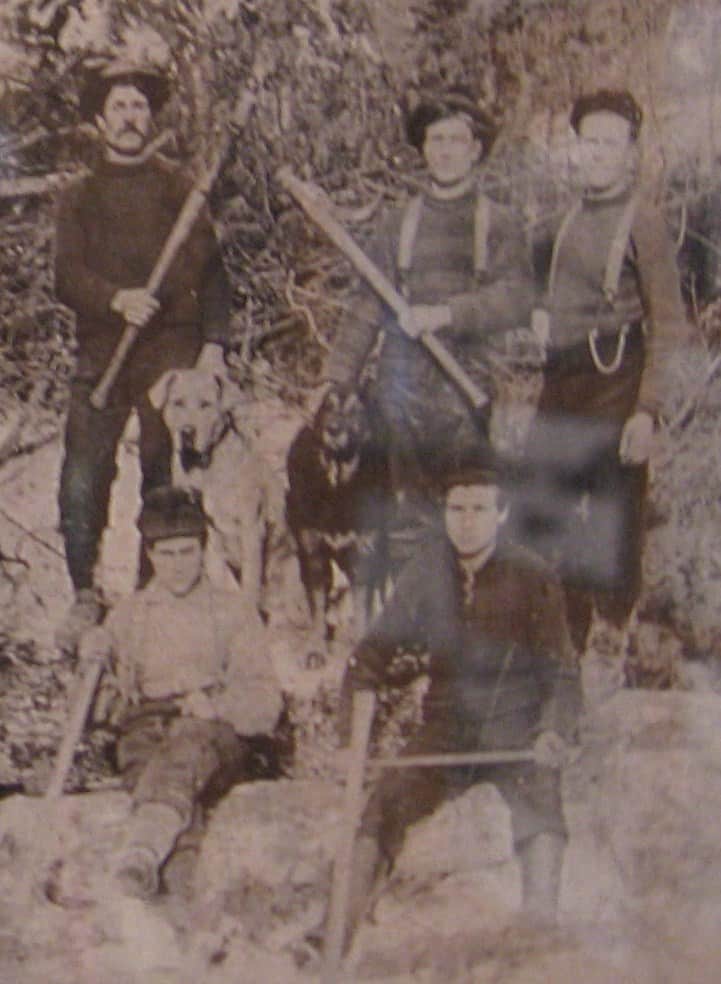
By the 18th century bataireacht became increasingly associated with Irish gangs called “factions”. Irish faction fights involved large groups of men (and sometimes women) who engaged in melees at county fairs, weddings, funerals, or any other convenient gathering. Some historians believe that this reflected a culture of recreational violence, while others argue that faction fighting had class and political overtones.
By the early 19th century, these gangs had organized into the Caravat and Shanavest factions. Beginning in Munster, the Caravat and Shanavest “war” erupted sporadically throughout the 19th century and caused some serious disturbances.
As the faction fights became increasingly repressed and other sports such as hurling were promoted, bataireacht slowly faded away by the turn of the 20th century. It has become mostly an underground practice saved by a few families who still handed down their own styles.
A few forms of bataireacht survive to this day, some of which are traditional styles specific to the family which carried them down through the years, like the rince an bhata uisce bheatha (‘dance of the whiskey stick’) style of the Doyle family of Newfoundland, taught in Canada, USA, and Germany.
Additionally, members of the Western martial arts movement have “reconstructed” styles using period martial arts manuals, historical newspaper articles, magazines, pictorial evidence and court documents.
Source: Wiki


https://www.youtube.com/watch?v=REvuqH8cRJc
Learn more: shillelaghuniversity
LUA
Origin: Kingdom Of Hawai’i
Description: Kapu Kuʻialua or Kuʻialua or Lua is an ancient Hawaiian martial art based on bone breaking, joint locks, throws, pressure point manipulation, strikes, usage of various weapons, battlefield strategy, open ocean warfare as well as the usage of introduced firearms from the Europeans.
The fighting art was referred to as “Kuʻialua”, literally meaning two hits. That name was subsequently given to the god of this martial art. Only those associated with the aliʻi (nobility), such as professional warriors, guardsmen, and members of the royal families, were generally taught Kuʻialua. During times of warfare, the makaʻāinana (commoners) were also instructed in the basic movements and functions of the martial art.
The old warriors of this art would coat themselves with a thin layer of coconut oil and remove all of their body hair in order to be able slip away and avoid being grappled in battle. The word for Lua masters, ʻōlohe, literally means “hairless”.
The art is truly fearsome, and made the Gangs of New York look like larping – brass knuckles are for sissies until you add actual shark’s teeth to them. Weapons used in Lua include the Hoe Leiomano (Paddle shark tooth weapon), Ihe (Short spear), Kaʻane (Garrote), Koʻokoʻo (Long and short staff), Kuʻekuʻe Lima Leiomanō (Brass knuckles), Maʻa (Sling), Newa (Short club), Pahi (Knife).


Learn more: olohe.com
OKICHITAW
Origin: Plains Cree First Nations
Description: Okichitaw is based on the Plains-Cree word okichitawak which was a title bestowed upon a Cree warrior by their Elders. An okichitawak was a warrior who had proven themselves skilled in the arts of survival, protection and warfare. When Plains-Cree native George Lépine was researching and developing the martial art the name okichitawak was suggested by Elders in Manitoba, but was modified to Okichitaw so that non-Cree speakers could pronounce it with greater ease.
George Lépine had been studying various martial arts systems since he was 13 years old and was always encouraged by both his instructors and Elders to embrace his indigenous traditions in his pursuit of martial skill and knowledge. Having grown up in Manitoba, Lépine had been taught hunting, tracking, wrestling, weapon and throwing practices from an early age. He decided to combine the values of his Aboriginal culture with the Canadian Cree combat principles and methods, using both what he had been taught and what he had learned through his own extensive historical research. Through hard work, training, research and practice Lepine created Okichitaw, codifying and systematizing it into a modern martial art. This was no small task since there was a scarcity of original reference materials and much of what has survived of Canada’s Indigenous records have been passed down orally through the centuries.
In 2002 at the Chungju World Martial Arts Festival, George Lépine presented Okichitaw where it was officially recognized as a unique aboriginal martial art of Canada — the first to be accepted by the World Martial Arts Union.


Learn more: nativemartialarts.ca/